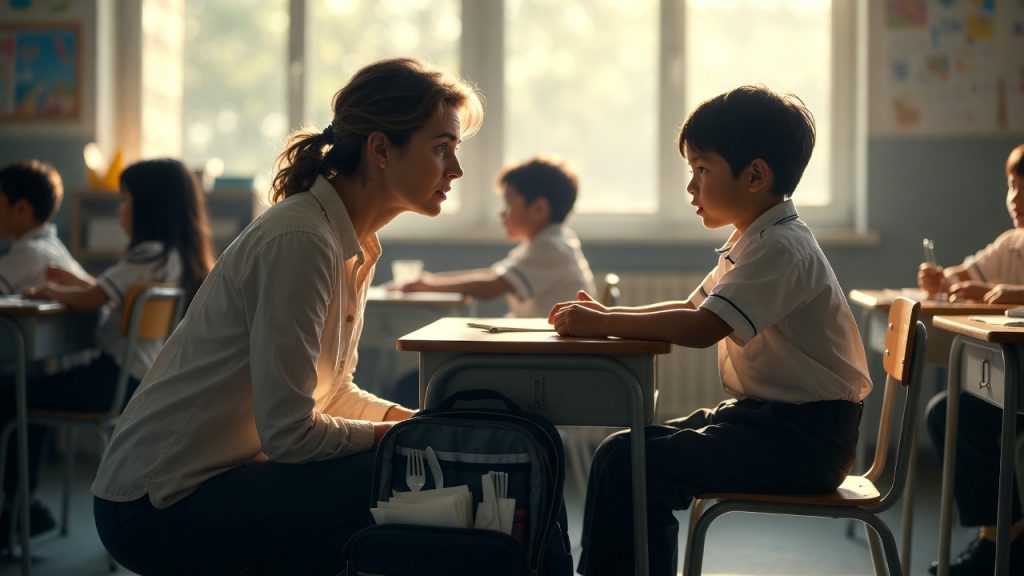
The first thing Mrs. Calder noticed was the backpack.
It was always under the same table, tucked neatly against the leg like it belonged there. Not tossed aside the way students usually treated their things, but placed carefully, almost respectfully. Dark blue. Frayed zipper. Heavy enough that it never slumped over.
At first, she assumed it belonged to one of the regulars.
The library at Lincoln High stayed open later than most, thanks to a district grant that encouraged “safe academic spaces.” In practice, that meant a handful of students who lingered after hours—studying, waiting for rides, killing time.
By October, Mrs. Calder knew their names.
But she didn’t know his.
He sat at the long table near the history section every afternoon, posture stiff, eyes fixed on whatever book he’d chosen that day. Sometimes it was a textbook. Sometimes a paperback novel with a cracked spine. He never used a laptop. Never plugged in a phone.
And he never spoke unless spoken to.
When the final bell rang at 3:15, the library slowly emptied. By five o’clock, there were usually only two or three students left.
By six, just him.
Mrs. Calder had worked as a school librarian for twenty-seven years. She knew the rhythms of teenagers the way some people knew music. She could tell who was procrastinating, who was lonely, who was hiding from something.
This boy wasn’t hiding.
He was waiting.
Every evening at 6:45, he glanced at the wall clock. At 6:50, his leg began to bounce. At 6:55, he packed his bag with exaggerated slowness, sliding books inside like he was afraid to make noise.
At exactly 7:00 p.m., when Mrs. Calder announced closing time, he flinched.
“Library’s closing,” she said gently, every night.
“Yes, ma’am,” he replied, every night.
He never complained. Never asked for more time. Just shouldered the heavy backpack and walked out into the dark.
Winter came early that year.
By November, it was already pitch-black by closing time. Rain slicked the sidewalks. Wind rattled the bare branches outside the tall windows.
Mrs. Calder started to worry.
She offered him a granola bar once. He declined politely. Offered to help with homework. He thanked her and said he was fine.
But he never went home early.
One Tuesday, a power outage swept through half the town.
The library lights flickered, then died. Emergency lighting hummed on, casting the room in a dull amber glow. Mrs. Calder gathered her things, preparing to close early.
“Take your time,” she told the boy. “It’s not safe to rush in the dark.”
He nodded, but his eyes darted toward the exit.
When he finally left, Mrs. Calder locked up behind him.
And then, for the first time, she followed.
She kept her distance, heart pounding like she was doing something wrong. The boy walked quickly, hands jammed into his jacket pockets, head down against the cold.
He didn’t turn toward the residential streets.
He walked straight to the bus station.
Mrs. Calder stopped across the street, half-hidden behind a parked car.
She watched as he slipped behind a row of vending machines, spread an old jacket on the ground, and curled up with his backpack hugged to his chest.
Her breath caught.
The realization hit her not all at once, but in heavy waves. The late hours. The backpack. The flinch at closing time.
He wasn’t staying late to study.
He was staying because there was nowhere else to go.
Mrs. Calder stood there longer than she meant to, frozen by the weight of what she’d seen. When she finally drove home, she barely remembered the trip.
That night, she didn’t sleep.
The next morning, she arrived at the library an hour early.
She unlocked the doors, turned on every light, and set a chair near the history section—the one he always used. On it, she placed a folded blanket she’d brought from home.
At 7:12 a.m., the boy walked in.
He stopped short when he saw the lights.
“Am I early?” he asked, panic creeping into his voice.
“No,” Mrs. Calder said softly. “You’re right on time.”
He hesitated, then sat.
He stared at the blanket for a long moment before whispering, “Is this… for anyone?”
“For you,” she said.
He didn’t cry. He didn’t smile.
He just exhaled, like he’d been holding his breath for weeks.
Over the next few days, Mrs. Calder learned his name was Aaron. Sixteen. Quiet. Polite to a fault.
She didn’t ask about his parents. Not at first.
She learned instead that he loved history. That he hated math. That he read faster than anyone she’d ever met.
Eventually, the truth came out in pieces.
His mother had died two years earlier. His father struggled after that—lost his job, then the apartment. They bounced between friends’ couches until those ran out too. His father disappeared one night and never came back.
Aaron didn’t want to end up in the system.
So he didn’t tell anyone.
Mrs. Calder made some calls.
Not dramatic ones. Careful ones. The kind that respected dignity.
By December, Aaron had a temporary place to stay. By January, he had a permanent one. The library stayed open late anyway—but he no longer flinched at closing time.
The backpack still sat under the table.
It was lighter now.
On the last day before spring break, Aaron handed Mrs. Calder a book.
Inside the cover, he’d written a single sentence:
“Thank you for seeing me.”
Mrs. Calder placed it on the shelf behind her desk, where she could see it every day.
Some stories, she knew now, were quiet enough to sleep through—unless someone stayed late enough to notice.